
Adaptability challenges of core principles:
The core advantage of metal sheet fiber laser cutters is to produce a high-energy-density near-infrared laser beam, which vaporizes and separates the material through instantaneous high temperature.As a natural composite material, wood's cellulose and lignin undergo rapid pyrolysis rather than simple vaporization when they encounter a laser focus of thousands of degrees.This directly leads to two key issues:
1.Unavoidable carbonization phenomenon: The wood at the edge of the laser path will form a carbonized layer due to heat conduction, which affects the beauty and accuracy of the cutting surface. The higher the density of wood (such as oak and red sandalwood), the more obvious the carbonization trend.
2.Control problems of combustion risk: The ignition point of wood is much lower than the operating temperature of the laser. If heat accumulates or oxygen is sufficient during the cutting process, it can easily cause open flames or smoldering, especially when dealing with dry thin wood chips or greasy wood.
Despite the challenges, modern metal sheet fiber laser cutters can effectively cut wood under specific conditions through process improvements:
The delicate balance of power and speed: The use of lower laser power (much lower than that required for cutting metal) with high-speed movement, shortens the time of action of the laser at a single point, and significantly reduces heat accumulation. The continuous purging of auxiliary gases (such as compressed air) not only cools the joints, but also blows away combustible debris in time.
Intelligent application of pulse mode: Changing the continuous laser to pulse mode allows the material to dissipate heat during the intermittent laser period, which can greatly improve the edge quality. Fiber laser cutters is particularly suitable for carving fine patterns or cutting heat-sensitive wood.
Material selection priority: Evenly dried hardwoods (such as birch, maple) or medium density fiberboard (MDF) are usually more suitable for laser processing than softwood or plywood containing turpentine. The former has small thermal deformation, while the latter can easily release harmful fumes or adhere to equipment.
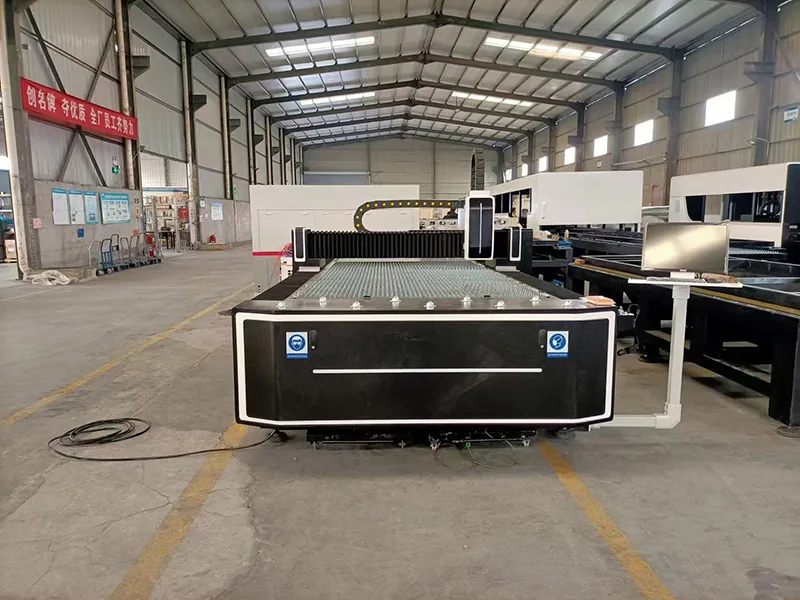
The use of metal sheet fiber laser cutters to process wood should be strictly prohibited in the following cases:
Chemically treated wood: Wood with painted, coated or soaked in preservatives on the surface, laser high temperature will decompose the coating and release toxic gases (such as formaldehyde and cyanide).
High-fat wood: Wood rich in natural oils such as green sandalwood and teak can easily catch fire and produce thick smoke when cut.
Too thick or too wet wood: Solid wood with a thickness of more than 15mm or wood with a high moisture content, the heat cannot be dissipated in time, and the risk of combustion increases sharply.
It must be admitted that the processing of wood by metal sheet fiber laser cutters is essentially an exploration that breaks through the boundaries of equipment design. For applications that pursue high-quality cutting surfaces (such as no carbonization, no scorch marks) or processing thick wood, traditional mechanical engraving, CNC milling or waterjet cutting are still more reliable and economical choices. The laser process is more suitable for specific scenes such as fine hollowing out of thin wood panels (usually ≤8mm is recommended), sign engraving, etc.
Metal sheet fiber laser cutters has the theoretical foundation and technical means of cutting wood, but it is not a panacea.Its core value lies in providing the possibility of non-contact precision machining for specific thin wood parts. We must be clearly aware of the limitations of metal sheet fiber laser cutters: The existence of carbonization edges, strict material screening requirements, and the constant pressure to control combustion risks. When deciding whether to adopt this process, the processing objectives, material characteristics and safety costs should be considered comprehensively. For conventional wood production, it is usually wiser and more efficient to give priority to processing equipment designed for wood.