
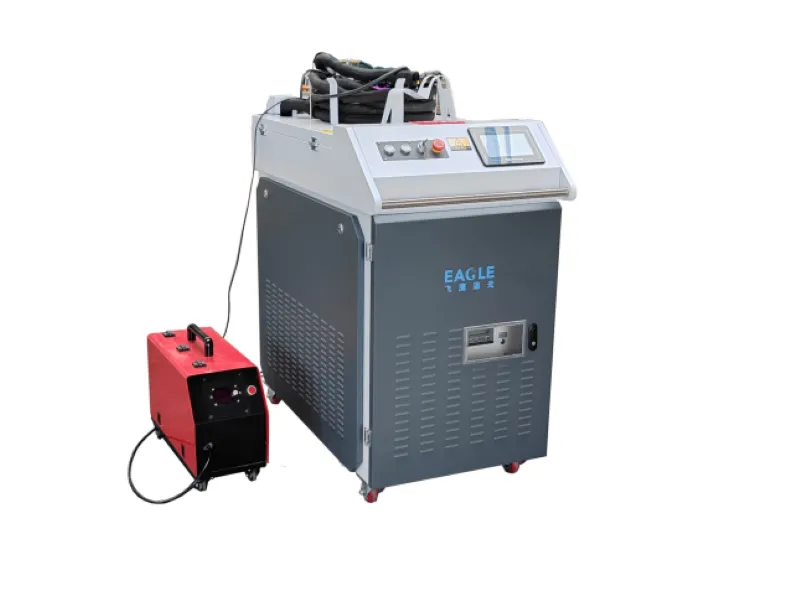
Fiber laser welding machines are one type among many, characterized by fine welds, deep penetration, small dimensions, and high precision; a smooth, flat, and aesthetically pleasing appearance; and great flexibility. However, many people worry about the short service life when purchasing a fiber laser welding machine. What's the reason for this, and how long does a fiber laser welding machine actually last?
Generally speaking, laser equipment has a very long service life, typically around eight to ten years. Of course, fiber laser welding machines are no exception. This is one of its most prominent advantages compared to other welding equipment.
A fiber laser welding machine can be used for eight to ten years, with prices ranging from tens of thousands to millions of yuan. However, this pricing varies depending on the brand, functions, and specific requirements.
Fiber laser welding machines can adapt to various complex welds, spot welding of various components, and seam welding of thin plates within 1mm. They use imported British ceramic focusing cavities, which are corrosion-resistant and high-temperature resistant, with a cavity life of 8-10 years and a xenon lamp life of over 8 million times.
After reading the above content, you should have a better understanding of the service life of fiber laser welding machines.
Although the overall lifespan of a fiber laser welding machine can reach 8-10 years, this is contingent on the user choosing the right configuration and a high-quality brand during purchase. If the core components are substandard, even a new machine may quickly develop problems. The following aspects are particularly important to consider when purchasing:
1. Laser (Core Component)
The laser is the "heart" of the entire equipment, determining the stability and service life of the welding process.
Brand: Internationally renowned brands usually have a longer lifespan and higher stability.
Beam quality: A good laser ensures uniform energy distribution of the laser spot, avoiding weld defects.
Heat dissipation performance: Poor heat dissipation will directly shorten the laser's lifespan.
2. Laser Power
The power level determines the thickness of the materials that can be welded and the efficiency.
Low power (500W-1000W): Suitable for thin plates and precision parts welding.
Medium power (1500W-2000W): Suitable for general metal structural parts and automotive components. High power (3000W and above): Suitable for welding thick plates, large areas, and high-efficiency production.
Companies should choose the power level based on actual applications to avoid "insufficient power for welding" or "excessive power wasting investment."
3. Optical Components and Cavity
Fiber laser welding machines often use imported ceramic focusing cavities, which are resistant to high temperatures and corrosion. High-quality cavities typically have a lifespan of 8-10 years, while xenon lamps can last for over 8 million cycles. When purchasing, confirm that the supplier uses genuine imported components to ensure long-term stability.
4. Welding Method and Control System
Operation method: Does it support spot welding, seam welding, and multi-beam welding?
Control system: A highly intelligent system can automatically adjust parameters, reducing human error.
Monitoring system: CCD camera monitoring allows real-time viewing of welding results, ensuring accuracy.
5. After-Sales and Maintenance Services
Even the best equipment requires maintenance. Choosing a manufacturer with a comprehensive after-sales service system ensures that problems during equipment use can be resolved promptly, avoiding losses caused by downtime.
How to extend the lifespan of a fiber laser welding machine?
In addition to focusing on core components during purchase, daily use and maintenance are equally crucial. The following points are effective methods for extending lifespan:
Keep the equipment clean: Regularly clean the optical lenses and cooling system to prevent dust and oil from affecting laser transmission.
Strictly follow operating procedures: Avoid overloading and do not arbitrarily change equipment parameters.
Regular maintenance: Check whether the optical path, cooling system, and power supply system are working properly to prevent problems before they occur.
Use original manufacturer consumables: Such as protective lenses and coolant; do not use inferior substitutes to save costs.
Good working environment: Avoid high temperature, humidity, and excessive dust, which is beneficial for extending the lifespan of the laser and optical components.
The service life of a fiber laser welding machine can usually reach 8-10 years, which is far superior to many traditional welding equipment. However, the lifespan depends not only on the equipment itself, but also on the quality of core components, reasonable configuration during purchase, and daily maintenance.
If companies focus on core factors such as the laser, power, cavity material, and control system during purchase, and strengthen maintenance management later, they can maximize the value of the equipment and achieve a higher return on investment.