The continuous development of laser technology has led to increasingly widespread applications of laser marking equipment in various industries, such as mobile phones, jewelry, hardware products, knives and kitchenware, tools and accessories, and automotive parts. Laser marking machines can be used to mark products in all these industries.
So, can a laser marking machine mark on cardboard boxes?
The answer is yes. A CO2 laser marking machine can mark the required patterns and text on cardboard boxes. A CO2 laser marking machine uses a laser beam to create permanent text markings on the surface of the cardboard box. The marking effect is achieved by vaporizing the surface material to expose the underlying material, thus engraving exquisite text, patterns, logos, dates, etc. Compared with traditional inkjet technology, CO2 laser marking machines have the advantages of clear laser marking, high speed, high yield, no pollution, and beautiful and permanent markings.
Currently, CO2 laser marking machines are mainly used in applications requiring higher precision and accuracy. They can not only mark on cardboard boxes but are also widely used in craft gifts, wood, clothing, greeting cards, electronic components, plastics, models, pharmaceutical packaging, architectural ceramics, and fabric cutting industries, such as leather laser marking, wooden packaging boxes, chopstick engraving, and pharmaceutical packaging box marking.
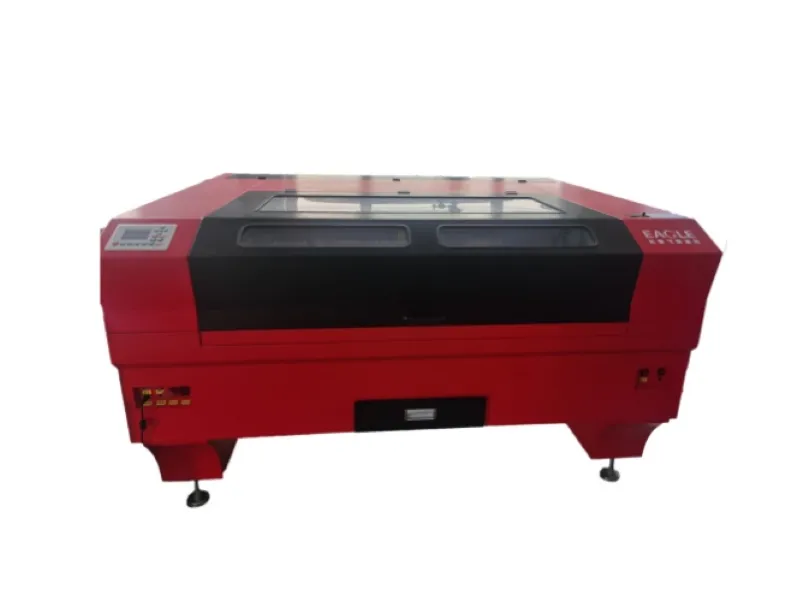
Advantages of Laser Marking Machines:
1. Non-contact processing allows marking on any regular or irregular surface, and the workpiece will not generate internal stress after marking, greatly increasing the range of marking applications.
2. Laser marking machines have a wide range of material applicability and can mark on different types or hardnesses of materials such as metal, plastic, ceramic, glass, paper, and leather, while ensuring excellent marking results.
3. Laser marking machines are highly adaptable and flexible, and can be integrated with other equipment on the production line to improve the automation level of the production line.
4. The marking effect is clear, durable, and aesthetically pleasing, and can effectively prevent counterfeiting; the marking machine replaces traditional inkjet printers, with no consumables, long service life, and no pollution.
5. Low operating cost, fast marking speed, and one-time marking, low energy consumption, and low operating cost. 6. It significantly improves processing efficiency. Laser marking systems are equipped with computer control systems and can be flexibly integrated with high-speed production lines;
7. Laser marking machines have a fast development speed. Due to the combination of laser technology and computer technology, users can achieve laser printing output simply by programming on a computer, and can change the printing design at any time, fundamentally replacing the traditional mold making process and providing a convenient tool for shortening product upgrade cycles and flexible production;
8. High processing accuracy. The laser can act on the material surface with an extremely fine beam, with the finest line width reaching the micron level, opening up a wide range of application possibilities for precision processing and enhanced anti-counterfeiting functions;
9. Low maintenance costs. Laser marking is a non-contact marking method, unlike stencil printing processes, which have limitations on service life, resulting in extremely low maintenance costs in mass production.
10. Environmentally friendly. Laser marking is a non-contact marking method, saving energy and avoiding chemical pollution compared to etching methods; it also reduces noise pollution compared to mechanical marking.
Laser marking machines use radio frequency lasers and high-speed galvanometers and perform non-contact marking through computer control of the laser beam. Graphics, text, and serial numbers can all be edited through software, making changes convenient and production costs low.