

What is a fiber continuous welding machine?
A fiber continuous welding machine is a high-end, new type of welding method, generally composed of a "welding host" and a "welding workbench". The laser beam is coupled to an optical fiber, transmitted over a long distance, and then processed into parallel light beams that are focused on the workpiece for continuous welding. Due to the continuous nature of the light output, the welding effect is stronger, and the weld seam is finer and more aesthetically pleasing. Depending on different industries and needs, the equipment can be customized in terms of shape and workbench to match the production site and achieve automated operation, fully meeting the needs of users in different industries.
What are the advantages of a fiber continuous welding machine?
In addition to the advantages of fast welding speed, minimal deformation, and no bubbles that ordinary welding machines offer, it also has the following advantages. First, this welding machine can perform non-contact welding on hard-to-reach areas, making the operation more flexible; it also incorporates a CCD camera monitoring system, which facilitates precise positioning and allows for easy observation of the welding process. The uniform energy distribution of the weld spot ensures the aesthetics and performance of the welded workpiece; it helps enterprises achieve automated factories, enabling multi-beam processing and mass production, demonstrating a higher output ratio advantage compared to similar products; finally, the laser of the welding machine uses imported materials, with a service life of up to 10 years or more.
What are the main applications of fiber continuous welding machines?
Due to its increasing intelligence, the fiber continuous welding machine has become a high-end product in the welding field, and is particularly favored in industries requiring precision welding. This machine is suitable for welding various metals and their alloys, and can also perform precision welding between the same or different metals. Therefore, it has been widely used in high-end industries such as aerospace equipment, shipbuilding, instrumentation, electromechanical products, and automobile manufacturing.
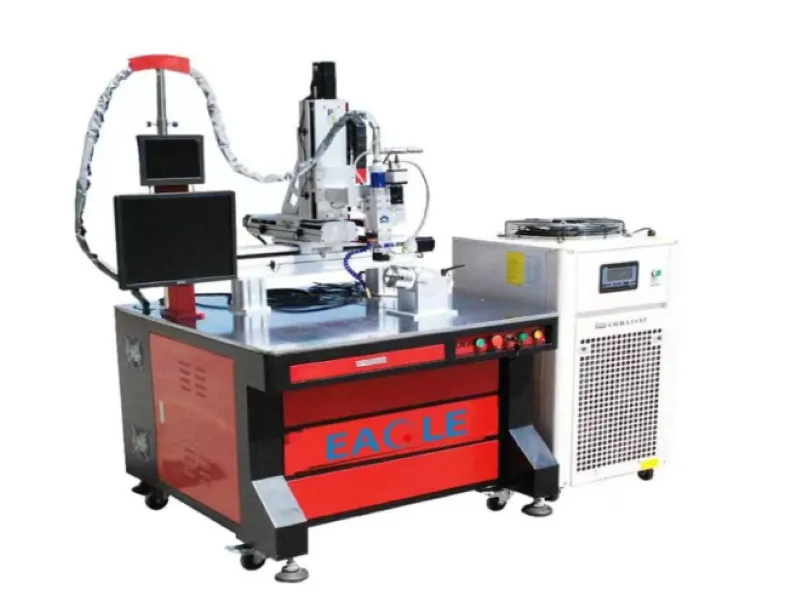
Comparison of fiber continuous welding machines with traditional welding methods:
Compared with traditional processes such as arc welding and tungsten inert gas welding, fiber continuous laser welding machines have significant advantages in welding speed, accuracy, energy consumption, and subsequent maintenance. It can minimize the heat-affected zone, avoid workpiece deformation, and achieve efficient energy utilization, conforming to the development trend of "energy saving, high efficiency, and environmental protection" in modern manufacturing.
Are fiber continuous welding machines expensive? The initial investment in laser welding machines is indeed higher than traditional equipment, but in the long run, thanks to low consumables, low labor costs, and low maintenance costs, they often help companies achieve a higher ROI (Return on Investment).
Can all metals be welded with a fiber laser continuous welding machine?
Almost all common metals and their alloys (such as carbon steel, stainless steel, aluminum alloys, titanium alloys, etc.) can be welded, and it can even achieve welding between different metals.
Is there any danger to operators from fiber laser continuous welding machines?
Laser welding is a beam processing technology. The equipment is generally equipped with safety shields and monitoring systems. As long as it is used according to standard operating procedures, the safety is very high.
Market Trends and Future Development:
Smarter: Combining with AI to achieve adaptive welding parameter adjustment.
Higher Power: Meeting the welding needs of complex workpieces and thick plates.
More Automated Applications: Integrating with robots and CNC machining centers to create unmanned production lines.
More Environmentally Friendly: Low energy consumption and less pollution, meeting the requirements of sustainable development.
According to industry research reports, the laser welding market size will maintain rapid growth in the next 5-10 years, especially in the new energy vehicle and energy storage battery fields, where the application demand for fiber laser continuous welding will increase significantly.
Fiber laser continuous welding machines, with their high precision, high efficiency, long lifespan, and automation adaptability, help companies solve the pain points in traditional welding and have played a core role in various industries such as aerospace, automotive, electronics, and medical.
If you are looking for a welding solution with higher quality, higher efficiency, and lower labor costs, then a fiber laser continuous welding machine is worth serious consideration.