
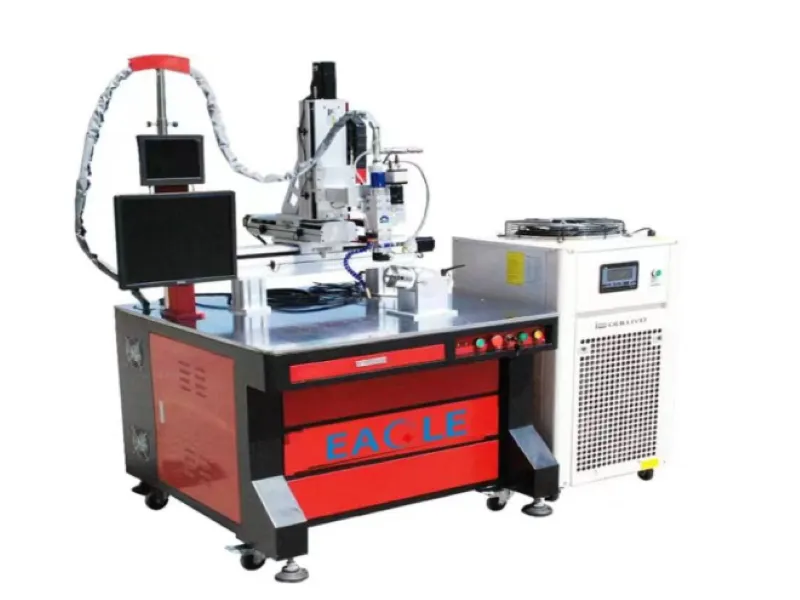
Fiber laser welding machines offer significant advantages over other welding machines, including smaller welds, high precision, and faster speeds, and can easily be integrated with automated fixtures for automated welding production. However, some people still wonder why the welds sometimes turn black despite these advantages. This is primarily due to oxidation.
1. Reasons for Black Welds
The main reason for black welds is oxidation. During the welding process, the fiber laser generates a high-energy beam, causing the welding area to heat up rapidly. If the weld point is exposed to air at this high temperature, the metal surface reacts with oxygen to form oxides (such as ferric oxide and magnetite), which are black, causing the weld point to turn black.
Under normal conditions, the ideal weld color should be the natural color of the metal or white, but oxidation in the air changes the color of the weld, affecting its appearance and meeting the requirements of some applications.
2. Methods to Prevent Black Welds
Based on industrial practice, the following two methods are commonly used:
(1) Using Protective Gas
During the welding process, blowing an inert gas, such as nitrogen, helium, or argon, into the weld area effectively isolates the weld from oxygen in the air, preventing oxidation during welding. The protective gas flow rate, nozzle angle, and coverage area need to be adjusted according to the material and thickness of the workpiece to obtain the best weld results.
(2) Welding in a Vacuum Environment
Welding in a vacuum environment completely avoids oxidation problems, but this method requires high-end equipment and has higher production costs, and is generally only used for special precision parts or high-end products.
3. Practical Suggestions
For most industrial applications, using nitrogen or helium protection is sufficient to meet the weld appearance requirements, and is simple to operate and moderately priced.
For parts with extremely high appearance requirements or special requirements for the performance of the welded metal, vacuum welding can be considered, but a comprehensive assessment of production volume and cost is necessary.
Operators should pay attention to matching the protective gas flow rate, welding speed, and laser power to avoid weld color deviations or weld quality problems due to improper parameter settings.
The blackening of welds from fiber laser welding machines is mainly due to instantaneous oxidation at high temperatures. This can be effectively prevented through the use of professional protective gases or special environmental controls. Our company has extensive experience in the application and technological optimization of fiber laser welding equipment. We can provide customers with welding process optimization solutions to ensure aesthetically pleasing and consistently high-quality weld joints. We also continuously share the latest welding technologies and practical case studies to help customers improve production efficiency and product quality.