
In the wood products industry, from furniture manufacturing, building decoration to handicraft carving, surface cleaning is a key part of the production process. Traditional cleaning methods such as mechanical polishing, chemical solvent cleaning and high-pressure washing generally have obvious limitations. These methods not only rely on consumables such as abrasives and chemical reagents, but also produce secondary waste, increase processing costs, and are difficult to achieve automated operations, labor-intensive, and consistent cleaning quality.
The emergence of laser cleaning technology has provided a new path to solve the pain points of these industries. The core advantages of laser cleaning machine are significant: first, it has strong precise control ability, flexible adjustment of spot diameter, and can be adapted to the local cleaning needs of complex grain wood; Second, it has outstanding environmental protection performance, does not require the use of chemical solvents, reduces volatile organic compound emissions, and complies with relevant EU environmental protection standards; third, it has high cleaning efficiency, which is greatly improved compared to traditional mechanical polishing.
There are two main mechanisms of laser cleaning. The photothermal effect is that after the pollutant absorbs the high-energy laser, the temperature rises sharply in a very short period of time, surpassing the gasification point or boiling point, and it is peeled off from the surface of the substrate through instantaneous evaporation or thermal expansion, which has a significant effect on the paint and glue residues on the surface of the wood. The photochemical effect uses the high single-photon energy of short-wavelength lasers such as ultraviolet light to directly interrupt the chemical bonds of specific pollutants and decompose them into volatile small molecules to achieve “cold” stripping. The heat-affected zone is very small, which is suitable for the treatment of heat-sensitive wood and precious cultural relics.
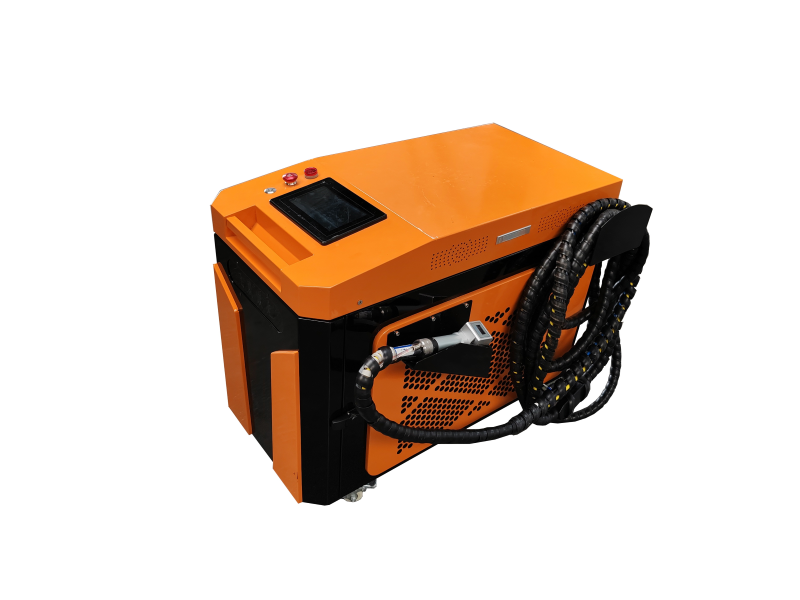
To achieve efficient and non-destructive laser cleaning of wood, key process parameters need to be rationally matched. In terms of laser selection, fiber lasers are widely used, have a good absorption rate of a variety of pollutants, and penetrate wood shallowly; Although CO2 cleaning lasers have a high absorption rate of wood, they are mostly used for cutting and engraving, and they are easy to damage the substrate when cleaning. Extra caution is required; ULTRAVIOLET lasers have little thermal impact and are suitable for precious wood treatment, but the equipment cost is higher. The power and energy density need to be strictly controlled, and too high can easily lead to carbonization and combustion of wood; The shorter the pulse duration, the smaller the heat-affected area, which is more suitable for heat-sensitive wood; the scanning speed and repetition frequency need to be balanced to avoid wood burns or incomplete cleaning due to improper parameters.
In terms of application scenarios, laser cleaning has great potential. In the manufacturing and remanufacturing of high-end furniture, glue residues can be accurately removed, the plates can be pretreated to improve the adhesion of the coating, and the paint layer of old furniture can be removed for renovation, while protecting the wood substrate and improving the subsequent coating effect. The restoration of ancient buildings and wooden cultural relics is its high-value application field. It can remove the oxide layer from the layered woodcarving of complex textures without damaging the original wood grain. In the cleaning of wooden molds, the remaining resins and adhesives on the surface of the molds can be quickly cleaned to improve production efficiency and product quality.
Judging from the development trend, with the maturity of fiber laser technology and the increase of localization rate, the cost of laser cleaning equipment has decreased year by year, and it is expected to spread to small and medium-sized wood products enterprises in the future. At the same time, artificial intelligence and machine learning will be integrated into parameter optimization to reduce the operating threshold. In addition, laser technology may also be combined with wood modification to expand the scope of application. Laser cleaning technology is not only an efficient and accurate surface treatment tool, but also a green manufacturing method in line with sustainable development. In the future, it will achieve breakthroughs in high value-added fields and gradually penetrate into more wood product processing fields.