
Currently, industrial robots are widely utilized across various sectors, including automotive and auto parts manufacturing, mechanical processing, electronics and electrical engineering, rubber and plastics, the food industry, and wood and furniture manufacturing. In industrial production environments, various types of industrial robots—such as welding robots, assembly robots, and material handling robots—have been adopted on a massive scale.
Issues Encountered in Robotic Welding Applications and Their Solutions:
Weld Seam Deviation: This may be caused by an incorrect welding position or a failure in the robot's torch-seeking process.
In such cases, one must verify the accuracy of the TCP (Tool Center Point—the position of the torch tip) and make necessary adjustments. If this issue occurs frequently, the zero-point positions of all the robot's axes should be inspected and recalibrated to correct the error.
Undercutting: This is likely due to improperly selected welding parameters, or an incorrect torch angle or position; appropriate adjustments should be made to resolve this.
Porosity (Gas Pockets): This may result from inadequate gas shielding, an excessively thick primer coating on the workpiece, or insufficient dryness of the shielding gas; making the corresponding adjustments will resolve the issue.
Excessive Spatter: This may stem from improperly selected welding parameters, issues with the gas composition, or an excessive wire stick-out length. Solutions include appropriately adjusting the robot's power output to alter welding parameters, adjusting the gas mixer to modify the shielding gas ratio, or adjusting the relative position between the torch and the workpiece.
Crater Formation at the End of the Weld Seam: During programming, a "crater-filling" function can be added to the work steps to ensure the crater is filled in upon completion of the weld.
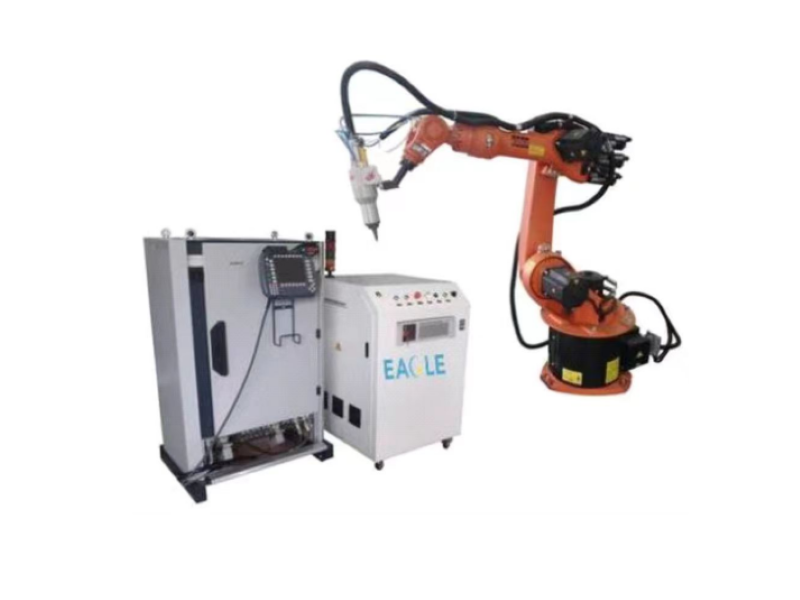
Common Robot System Faults During the Welding Process:
Torch Collision: This may be caused by deviations in workpiece assembly or an inaccurate torch TCP; inspect the assembly setup or recalibrate the torch TCP.
Arc Failure (Failure to Ignite Arc): This may occur if the welding wire fails to make contact with the workpiece or if the process parameters are set too low; solutions include manually feeding the wire, adjusting the distance between the torch and the weld seam, or appropriately adjusting the process parameters.
Shielding Gas Monitoring Alarm: This indicates a fault in the cooling water or shielding gas supply system; inspect the cooling water and shielding gas supply lines.
Currently, the adoption of robotic welding stands as a primary indicator of the modernization of welding automation technology. Thanks to their high versatility and operational reliability, welding robots are garnering increasing attention and importance within the industry. While robotic welding may occasionally encounter issues such as weld misalignment, undercut, porosity, or spatter during operation, these problems can be effectively avoided and resolved through the proper configuration of parameters, precise adjustment of the welding torch position, and the implementation of robust maintenance and process management practices. It is for this very reason that robotic welding has gradually emerged as a pivotal tool for the manufacturing sector to enhance both efficiency and quality.
Feiying offers high-performance robotic welding products, complemented by comprehensive process solutions and after-sales support, to assist clients in achieving stable and efficient welding operations across diverse production environments. If you are seeking a reliable welding automation solution, choosing our products will bring enhanced efficiency and reduced risk to your production line.