Introduction to laser cleaning technology:
The principle of laser cleaning is to use the high-energy characteristics of the beam emitted by the laser through the convergence and the directivity of the laser beam to remove pollutants from the surface of the body without causing damage to the matrix of the material body.
Laser cleaning technology is mainly divided into two methods: Dry cleaning and wet cleaning, and there are three main mechanisms of laser cleaning: Vaporization of contaminated particles, vibration removal of the substrate and dirt, and thermal expansion and detachment of dirt particles. Let's take a look at the technical principles of these three laser cleaning mechanisms of action.
1. Vaporization of dirt particles:
According to the difference in the light absorption rate of the laser by the workpiece material matrix and the dirt particle material, by selecting the appropriate laser parameters, the material matrix will reflect most of the laser, and the dirt particles absorb a lot of laser energy, causing themselves to be heated and vaporized to achieve the purpose of cleaning.
2. Vibration removal of substrate and dirt:
Using the characteristics of the small pulse width of the laser, under the repeated action of the pulse, the pollutants on the surface of the material cleaning the workpiece are impacted, which in turn causes it to break off or vibrate and pop up, so as to remove the pollutants without damaging the material matrix. The purpose.
3. Thermal expansion and detachment of dirt particles:
Using the high energy of the converging laser beam, by irradiating pollutants and absorbing energy, due to thermal expansion and contraction, the pollutants themselves will expand by heat, become larger or burst, reaching the limit of adsorption with the material matrix and fall off, thereby achieving the purpose of removing pollutants.
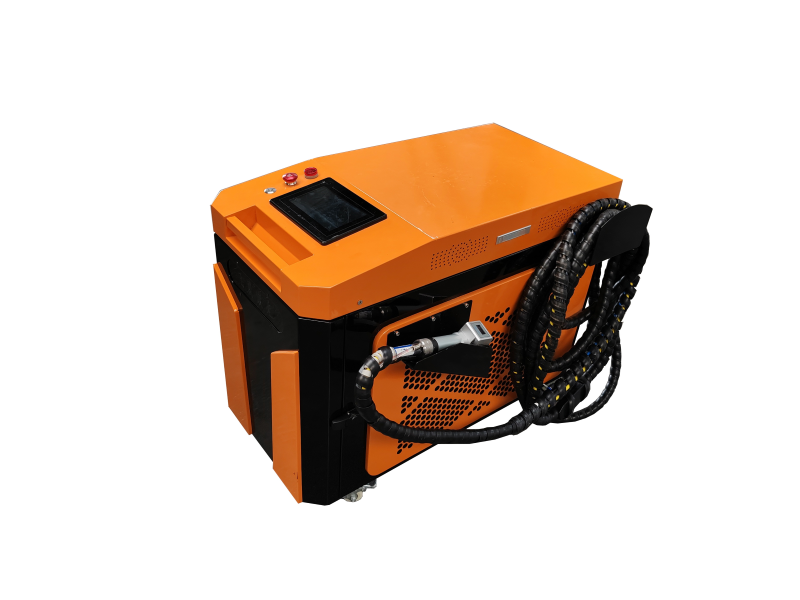
Comparison of laser cleaning technology and traditional cleaning technology:
Compared with the technical pain points of traditional cleaning technology and the disadvantages of actual production and application, the technical advantages of laser cleaning can be seen at a glance.
1. Comparison of environmental protection of cleaning:
The use of chemical cleaning fluid for cleaning or the use of any other chemical solution to clean production equipment or products usually has a certain degree of chemical waste liquid pollution to its environment, especially new types of stubborn stains with high adhesion usually require a large amount of highly corrosive chemical cleaning fluid. If the waste liquid is not properly treated, the pollution to the environment will be greater.
For laser cleaning operations, after the dust removal equipment treats the particles, it basically does not cause any environmental pollution, which is a reality.
A solid "green" cleaning process.In addition, laser cleaning is a kind of “non-contact cleaning” for laser equipment, which also greatly eliminates secondary pollution after cleaning of different equipment.
2. Comparison of cleaning fineness:
It is the inherent advantage of good directivity of lasers that makes them always occupy a dominant position in the fineness performance of various production operations.
Taking the cleaning of production molds as an example, if the cleaning is not thorough, the residues of the molds will have a great impact on the accuracy of the product. Traditional techniques for friction cleaning methods such as ordinary brushing, scrubbing, and high-pressure water gun jet washing of the molds, although large areas of pollution residues can be quickly removed, there will still be pollution residues in some small spaces. In addition, this kind of friction cleaning can easily damage the mold.
Laser cleaning can realize the accurate positioning of the laser beam in time and space through a professional computer, which is suitable for the “millimeter-level” cleaning needs of various complex shapes of production molds and hole-shaped structural parts. In addition, due to the good directivity of the laser, the direction of the laser head can be flexibly changed to guide the laser beam to clean the various lines and “sanitary dead ends” of the mold.
3. Comparison of cleaning efficiency:
For cleaning work such as paint removal, rust removal, and grease removal during the maintenance of large-scale industrial equipment and pipelines, if chemical cleaning fluid is used for cleaning, the equipment not only needs to be protected from liquid infiltration and damage, but also needs to be evenly sprayed with cleaning fluid, as well as subsequent painting of the base paint, and a series of complicated operations such as disposal of waste pollutants and waste liquid. This method is both time-consuming and laborious.
4. Comparison of cleaning applicability of different materials:
For traditional cleaning technologies, if the choice of cleaning technology is not appropriate, not only will it not achieve the expected effect of cleaning, but it will also bring losses to production; Especially chemical cleaning methods, it is necessary to consider the adverse consequences of the chemical action of its agents on the material of the cleaning object, such as corrosion of equipment parts, discoloration of the surface of the material, etc.; Each traditional cleaning technology has a smaller range of cleaning objects, and there are more comprehensive factors that need to be considered.
In contrast, laser cleaning technology is much easier. For all kinds of metals, wood, stone, concrete and composite materials, pulsed laser technology can be used for cleaning-just by adjusting the laser power, frequency and other laser parameters of the laser cleaning equipment, and then emitting laser beams with different energy densities and beam widths, the cleaning operation requirements of different materials and different standards can be easily realized. It is a “multi-purpose machine” in the true sense!
5. Other advantages of the laser cleaning process:
At present, laser cleaning equipment generally has a long service life under good maintenance conditions. At the same time, laser equipment mainly consumes electricity and energy, and does not require the addition of other consumables. Compared with traditional high-pressure water flushing, chemical cleaning and scrubbing, it also saves a certain cost of cleaning consumables in the cleaning operation; Laser cleaning operations are generally controllable, so that staff can observe the cleaning operation at any time, and at the same time, the laser cleaning equipment has low noise during work and will not cause excessive noise pollution to the work link.
In the protection of cultural relics, countries around the world have rarely used chemical cleaning methods and mechanical friction cleaning methods that may cause damage to precious cultural relics, and are gradually promoting the use of laser cleaning technology that is less harmful to the cultural relics themselves and has a better cleaning effect and more efficient.