In the field of precision manufacturing, hand held laser marking machine and laser engraving are often confused, but in fact, there are fundamental differences between the two from technical logic to application scenarios. As the key technology of industrial marking, understanding its essential differences will directly affect production efficiency and cost control. This article will focus on the core differences and analyze the unique positioning of fiber Hand Held laser marking machine machine in modern production.
1. Technical principle:
Hand held laser marking machine uses controllable laser energy to initiate physical or chemical changes (such as oxidation, crystallization and recombination) on the surface of the material to form a permanent mark. This process does not cut the material, only causes micron-level surface modification. With precise energy control, hand held laser marking machine machine has become the first choice for marking metal and plastic surfaces.
Laser engraving relies on high-energy lasers to vaporize or peel off materials to form visible grooves on the surface of the workpiece. Its essence is micro-cutting, the depth far exceeds the marking marks, and it is suitable for three-dimensional graphic forming.
2. The essential difference between effect and adaptability:
Laser marking takes “no contact and no deformation" as its core advantage. The marking produced by the hand held laser marking machine is smooth to the touch and completely maintains the original structural strength of the material. It is especially suitable for scenes with extremely high integrity requirements such as precision electronic components and medical devices. In contrast, laser engraving machines will inevitably change the surface shape of the workpiece due to the removal of materials. Although they can achieve three-dimensional effects such as relief and hollowing out, they may cause thermal deformation or edge carbonization, which is a risk to thin-walled parts or heat-sensitive materials.
3. The irreplaceable nature of fiber laser marking machine:
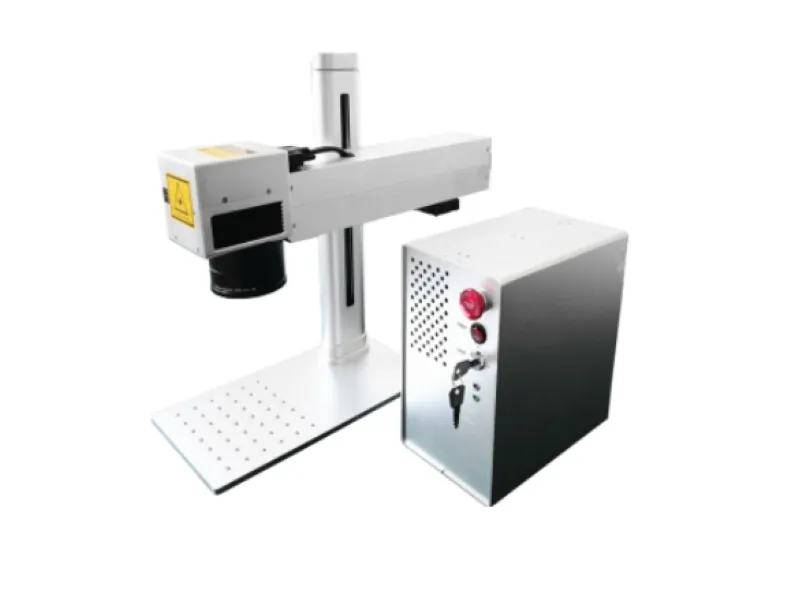
Among the industrial-grade marking requirements, hand held laser marking machine has demonstrated systematic advantages. It achieves micron-level graphic and text accuracy through very fine light spots, and can stably generate complex two-dimensional codes and fine text; Its high-speed response characteristics are perfectly adapted to the rhythm of automated assembly lines; And it is compatible with stainless steel, aluminum alloy, engineering plastics and other diverse materials. More importantly, it abandons the traditional ink or chemical etching process, promotes the transformation of green manufacturing with zero consumables, and becomes the standard equipment of modern smart factories.
4. The natural boundary of the application scenario:
The core mission of fiber laser marking machine lies in product traceability and brand identity. Whether it is the serial number of auto parts, the brand logo of the tool, or the parameter identification of the circuit board, it is necessary to rely on efficient and non-destructive surface marking technology. The value of laser engraving is reflected in the field of deep processing: The concave and convex texture of trophy inscriptions, the fine texture of leather molds, and the hollow structure of acrylic decorations all need to be removed through materials to achieve functional or aesthetic expression.
5. The decision-making logic of scientific choice:
Enterprises need to take the processing goal as the first guide: If only the surface is permanently marked and the efficiency is maximized, fiber laser marking machine is more suitable; If you need to shape three-dimensional structure or depth graphics, it is more suitable to turn to laser engraving equipment. At the same time, the material characteristics need to be evaluated-the engraving process should be used with caution for heat-sensitive materials, while heavy workpieces are more suitable for deep processing. The cost dimension cannot be ignored either: The energy consumption and maintenance costs of the marking process are significantly lower than that of engraving.
Laser marking and engraving are exactly like two sides of industrial precision machining. The former uses fiber laser marking machine as the fulcrum to support an efficient, clean, and minimally destructive marking system; The latter continues to expand the boundaries of personalized and functional processing. Together, the two have constructed a complete technical map of modern manufacturing. With the continuous evolution of optical fiber technology, laser marking will unlock greater potential in the field of high precision, driving the industry to a deep evolution of intelligence and sustainability.