
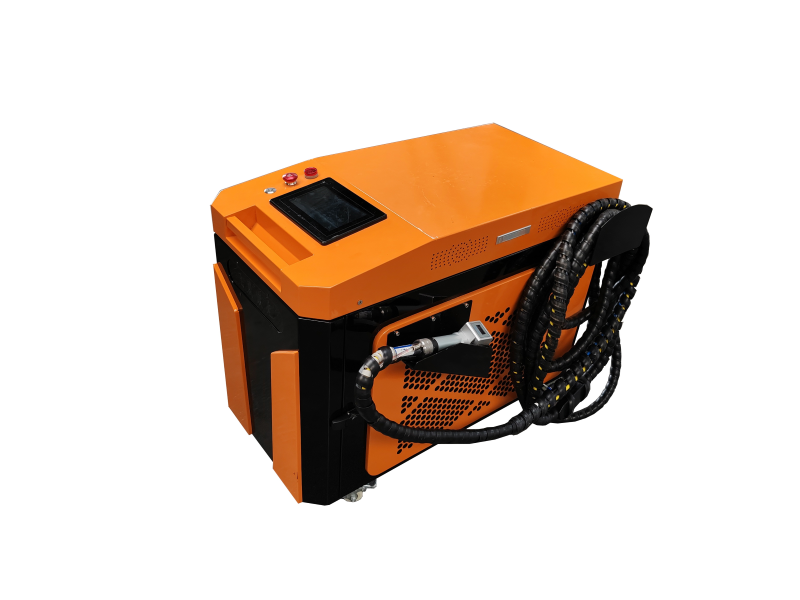
Simply put, a handheld laser cleaning machine uses lasers to achieve cleaning, also known as laser cleaning. Laser cleaning utilizes pulsed laser irradiation to clean the surface of an object. The adhering substances on the surface absorb the laser energy, causing thermal expansion and reducing the adhesion between the substrate and the adhering substances. Simultaneously, by outputting high-frequency pulsed laser energy, high-frequency vibration impacts are generated, causing the adhering substances to shatter and detach from the substrate. Handheld laser cleaning machines can remove paint from precision areas precisely where needed, without requiring covering or moving protective tools during each operation. Laser cleaning is effective for both partial and full surface coverage by organic matter, chemical oxides, and anodic oxides. The pulsed Nd:YAG laser cleaning process relies on the characteristics of the generated light pulses, based on a photophysical reaction caused by the interaction between a high-intensity beam, short-pulse laser, and the contaminant layer.
The physical principle can be summarized as follows:
(a) The laser beam emitted by the laser is absorbed by the contaminant layer on the surface to be treated.
(b) The absorption of high energy forms a rapidly expanding plasma (a highly ionized unstable gas), generating a shock wave.
(c) The shock wave fragments and removes the contaminants.
(d) The pulse width must be short enough to avoid heat buildup that could damage the treated surface.
(e) Experiments show that plasma is generated on the metal surface when oxides are present.
Plasma is generated only when the energy density is above a threshold, which depends on the level of contaminant or oxide layer being removed. This threshold effect is crucial for effective cleaning while ensuring the safety of the substrate material. There is also a second threshold for plasma generation. If the energy density exceeds this threshold, the substrate material will be damaged. To ensure effective cleaning while maintaining the safety of the substrate material, the laser parameters must be adjusted to keep the pulse energy density strictly between these two thresholds. Each laser pulse removes a certain thickness of contaminant layer. If the contaminant layer is thick, multiple pulses are required for cleaning. The number of pulses required to clean the surface depends on the degree of surface contamination. An important consequence of these two thresholds is the self-control of the cleaning process. Pulses with energy densities above the first threshold will continue to remove contaminants until they reach the substrate material. However, because their energy density is below the substrate material's damage threshold, the substrate will not be damaged. Laser cleaning, with its environmentally friendly, efficient, precise, and easily automated characteristics, is considered a disruptive industrial cleaning technology. Initially used in Europe for cleaning ancient buildings and cultural relics, its applications have gradually expanded to the industrial sector. In the last 20 years, developed Western countries have implemented mature, large-scale applications in fields such as aerospace, automotive, large-scale integrated circuits, cultural relic restoration, and high-end molds. Laser cleaning has been included in China's "Made in China 2025" industrial catalog, and with the increasing emphasis on environmental protection, it is poised for significant development opportunities and a broad market prospect.
Laser cleaning can replace traditional cleaning methods such as manual mechanical cleaning, chemical cleaning, sandblasting, ultrasonic cleaning, and dry ice cleaning. Compared to traditional methods, handheld laser cleaning machinesoffer numerous advantages: 1. Non-contact cleaning, no cleaning medium: Laser cleaning utilizes a high-energy laser beam to irradiate the surface of the workpiece, removing contaminants through selective vaporization, ablation, shock waves, and thermoelasticity. The absence of a cleaning medium during the process avoids the severe substrate damage (particulate cleaning) and media residue (chemical cleaning) problems associated with traditional cleaning methods, minimizing substrate damage to an acceptable level. 2. **Environmentally Friendly:** The fumes generated by laser cleaning can be collected by a dust collector, making it easy to handle and producing no irritating byproducts, minimizing its environmental impact. It does not use chemical reagents and produces no wastewater, dust, or other residues.
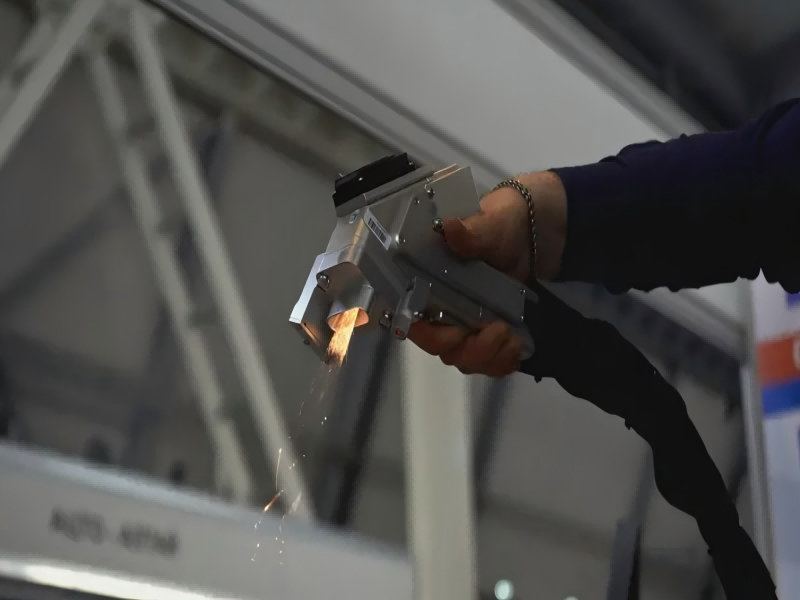
3. Diverse Operation Methods: Laser cleaning can be divided into handheld and automatic cleaning. Handheld cleaning involves the operator carrying a mobile laser cleaning device and holding the laser head for cleaning. Automatic cleaning integrates the laser cleaning system with robotic arms, crawling robots, AGVs, etc., achieving precise and efficient cleaning. It is simple to operate, requiring only power; its portable, integrated design makes it easy to integrate.
4. Handheld Laser Cleaning Machine: Laser cleaning can remove various types of contaminants. Whether the substance to be removed is organic, metal, oxide, or inorganic non-metal, laser cleaning can remove it, regardless of the product's shape or size. It offers high positioning accuracy and controllable removal thickness. This is an advantage that no other traditional method possesses, making it widely applicable in removing surface dirt, paint, rust, and films.
5. Low Operating Costs:Laser cleaning does not use consumables, resulting in lower operating costs compared to traditional methods. No consumables, high efficiency, maintenance-free, and low operating costs.
Surface laser cleaning technology is a rapidly developing new cleaning technology that has emerged in the last decade. Due to its many advantages, it is gradually replacing traditional surface treatment cleaning processes in many fields. It can handle various surface contaminants, has minimal environmental pollution, and does not damage the substrate. Currently, this method has become a supplement and extension to traditional cleaning methods and has shown broad application prospects due to its many inherent advantages. As a leading company in China's laser industry, Xiong Ying Laser has always been committed to the research and development and promotion of laser products. The newly launched handheld laser cleaning machine is not only of high quality but also has stable performance and a high cost-performance ratio, providing customers with excellent laser product solutions. Excellent service is the beginning of sales, and sales are the continuation of service! Creating timely and convenient service, lower after-sales costs, and a win-win situation is our unchanging principle!